Saturday, April 1, 2017

1984

     I'm sure I was supposed to read George Orwell's 1984 in high school. Like so many of the things I was supposed to do in high school, I didn't. It wasn't until Kellyanne Conway started promoting the acceptability of the concept of "alternative facts", and Sean Spicer began using White House press briefings as a platform to defend whatever outlandish and unfounded belief 45 had most recently spewed on twitter, that I finally read it.  My purchase of this book combined with that of thousands of Americans struggling for a way to think about "what the hell is going on", resulted in the book topping the Amazon charts and requiring Signet to order a 75,000 copy reprint. In broad terms the book is a warning about totalitarianism. Orwell outlines the structures that are necessary for a government to maintain complete control its people; of their thoughts as well as their behaviour. Chief among these is the ability of the leadership to lie about events, past and present, and to demand faith in that narrative; to fabricate facts, information, history, ultimately, reality.  Also important to the success of the dictatorship is fierce, blind nationalism, coupled with a reflexive fear and hatred of the outsider and of opposition. There's the propensity for classifying the citizenry, effectively reducing individuals to commodities; suspicion of creativity and individuality. There's the cult of personality required to encourage a proper fanaticism. I'm not going to get into a lengthy comparative analysis of the parallels between Orwell's narrative themes and the current movements in American politics. I will simply say this: you cannot read it today, without making comparisons and feeling an uncomfortable sense of recognition. There are those who will say that the world of 1984 is impossible in America today, but that is to take a literal reading. Orwell forces the reader to imagine the unimaginable, and in so doing to witness a terrifying and destructive dead end to a fascitic narrowing of thought, speech, truth, and freedom. The intent was not to paint a portrait of any real life nation or government, but to point to the signposts of fascist ideology and the degradation of the structures that hold government accountable to the people.
      Next Tuesday is April 4th, the anniversary of the day on which Orwell's protagonist, Winston Smith, began writing his diary. In the world of 1984, this was a forbidden act, one of resistance that Winston knew would likely mean his death. In opposition to the president's policies, in support of the arts and creativity, of free thought and objective fact, of liberal democracy, the Art House Convergence and United States of Cinema have organized a screening event of the 1984 film adaptation. On Tuesday more than 180 theaters in 43 states will show the movie. In my area, I have a choice of two theaters. Both are showing it for free, and are suggesting moviegoers make a $5 donation. The donations collected at one of those theaters will go to Planned Parenthood and the those collected at the other will benefit the National Endowment for the Arts. For more information on this event and to see a complete and linked, state by state list of participating movie houses, go here. http://www.unitedstateofcinema.com/
     Tuesday is a good night to go out. This is literally the easiest act of resistance I can think of. Go sit in a dark room and watch a movie. Give $5 to a worthy and threatened cause. Take friends and talk about truth and freedom and democracy and humanity over drinks or dinner. I know it sounds really hard, but you should do it because you can. You should do it because you know that 2+2 does not make 5. You should do it because it is not yet true that:

WAR IS PEACE
FREEDOM IS SLAVERY
IGNORANCE IS STRENGTH


Thursday, March 23, 2017

Hashtag Trypod

     If you are a podcast listener, you have probably heard the call to recommend a podcast to those in your life that may or may not be. This is a month long campaign by the podcasting community to increase awareness of the medium. They are suggesting that people use the hashtag "Trypod" when making their recommendations, but since don't do hashtags, I thought I'd run down some of my favorites in a blog post.
    This blog is typically concerned with matters of politics, so this will be something of an outlier; at least some of the podcasts on my list will be.  Some are explicitly about politics, some deal with issues relating to politics, and some are totally unrelated to, or distractions from politics. In a previous post, I addressed the challenge of getting news and information in a rational and self aware way. In that case, I was dealing primarily with print media. Aside from print, I mainly consume podcast and public radio media.  Because of the sometimes personal nature of podcasts, some of them are difficult to categorize, but I will do my best to put my recommendations into rough categories.
    In the context of this blog,  I think it makes sense to start with the category most relevant to politics. This also happens to be the most self evident and easily defined category; we'll call it "News, Politics, and Investigative Reporting". Included in this category are podcasts that offer a straightforward presentation, discussion, and analysis of current events.

News, Politics, and Investigative Reporting:

-The NPR politics podcast:
http://www.npr.org/podcasts/510310/npr-politics-podcast
       This is a weekly rundown and discussion of the week's political news by NPR's relevant correspondents (congress, justice, politics, demographics, etc.). In addition to the regular weekly show, they will post a shorter episode in the event of an important breaking political story ("Micheal Flynn Resigns", "President Trump Addresses Congress", "Trump's Travel Ban Halted").

-The Daily:
https://www.nytimes.com/2017/01/30/podcasts/the-daily-get-ready-for-the-daily-your-audio-news-report.html
      Hosted by Micheal Barbaro, this is a short daily (as the name implies) briefing on important news. There is typically an interview with someone with specific knowledge of the issues relevant to the big headline of the day followed by a rundown of "what else you need to know today."

-Political Gabfest:
http://www.slate.com/articles/podcasts/gabfest.html
     David Plots hosts this Slate podcast which deals with the week's main political developments. John Dickerson provides historical/political context, while Emily Bazelon talks about the legal implications.

-The Ezra Klien Show:
http://www.vox.com/ezra-klein-show-podcast
    Ezra Klien is the editor-in-chief of Vox.com. This podcast features  lengthy and in depth interviews with interesting guests representing a wide range of political views and professional fields. The conversations are always thoughtful, and never hyperbolic or adversarial.

-Embedded:
http://www.npr.org/podcasts/510311/embedded
     If you are an NPR fan, as I am, you'll like this one. Kelly McEvers, an NPR reporter, takes a story in the news and tries to get at the root of it by discussing it with the people it has touched on all sides. Fair warning, the subjects are often dark; think opiods, gang violence, police practices, immigration. What I really like about this one is how it destroys the caricatures on witch the typical arguments surrounding social issues are built. They could have called this one "Shit is complicated and messy", but "Embedded" does seem a bit more professional.

-Reveal:
https://www.revealnews.org/episodes/
     This one is in a similar vein to Embedded. Hosted by Jacksonville, FL native, (for all my hometown friends), this podcast investigates issues of social importance with the aim of understanding why perceptions and realities are what they are.


    I'm going to call the next category "Historical and Social Perspective". There are only a few podcasts in this one because a straight up delivery of this kind of stuff is boring, like lecture boring. I find this stuff fascinating when it is presented in an entertaining way, but lots of the podcasts that would fall into this category are just plain dull or are self indulgently dorky, either of which means that they are unlistenable. The podcasts I have chosen for this category are full of interesting and enlightening information while being entertaining.  While these podcasts deal with issues that are often politicized, they are not about politics. They help us better understand how these issues evolved and why we relate to them in the ways we do.

Historical and Social Perspective:

-More Perfect:
http://www.npr.org/podcasts/481105292/more-perfect
     My wife does our taxes because for me to do so is an absolute physical impossibility; that is how much legal language befuddles me. That may be why I love this podcast so much. It deals with some of the most consequential supreme court decisions by way of an investigation of the human stories behind them. It offers a natural and enjoyable way of understanding at least some parts of what often seems like an opaque and convoluted world that inevitably effects our lives and shapes our culture.

-Revisionist History:
http://revisionisthistory.com/
     You may know Malcolm Gladwell from his work at The New Yorker magazine or as the author of many books about "big picture" thinking.  His podcast is very much about examining our big collective "truths". He explores ideas about education, creativity/genius, and social commentary itself. His style is engaging and conversational and each episode forces you to think about something in a way you never had before.

-Hidden Brain:
http://www.npr.org/podcasts/510308/hidden-brain
    The warm and personable cadence to host, Shankar Vedantam's speech makes for pleasant listening. He also delves into the nuance and implications of the study of social sciences. He asks the questions that get to the root of why we think, decide, and behave the way we do, as well as how much of this tends to be conscious and how much is biological or chemical. It's a show about our "wiring".


    The next group of podcasts may seem sort of unrelated to each other, but that's because they are all tough to classify. I think what unites them is the topical format which organizes either the show itself or its individual episodes, so for the purposes of this list, I'm going to give this group the heading "Topical / Thematic".

Topical / Thematic:

-TED Radio Hour:
http://www.npr.org/podcasts/510298/ted-radio-hour
     "TED" stands for technology, entertainment, design, but those categories hardly seem to encompass everything covered in "TED Talks". If you have seen or heard any of these talks, you know that they can be simultaneously engrossing and daunting. The great thing about this podcast is that it takes a theme touched on by multiple TED speakers, and through interviews with those speakers and clips from their talks, tries to synthesize some basic truth. Host, Guy Raz, is a charming guide as his mind is routinely blown right along with yours.

-Invisibilia:
http://www.npr.org/podcasts/510307/invisibilia
   There is some overlap between this podcast and The hidden Brain Podcast mentioned in the previous category.  This one deals with the idiosyncrasies of the human brain from a more personal and storytelling perspective.

-Maeve in America:
https://www.maeveinamerica.com/
     Maeve Higgins is a comedian and an Irish immigrant. Her podcast connects with other immigrants and tells their stories. Some who have been living in America for decades and others who's struggles have brought them here quite recently and who's stories are still unfolding. Some are inspirational, some heartbreaking or maddening; all will make you think about what it means to be "American".

-Myoclonic Jerk:
http://www.myoclonicjerk.com/
    I was on the fence about including this one because I know it's not for everyone, but it was one of the first podcasts I ever really got into. It's funny, weird, entertaining, though provoking, silly, poignant; it's a lot of things. Mostly it's a thoughtful and honest guy wrestling with life's questions and enlisting people's help to do it. It's been a long time since I've listened to these, but word of warning: skip the "Sex" episode if discussion of non-traditional or seedy sexual behaviour bothers you, and skip the "Eating Animals" episode if you treasure a blissfully ignorant view of meat production.


    Sometimes you don't want to think about politics or what is happening in the world or about history or immigration or the supreme court or science or technology or our brains or anything. You want a distraction. That's what this last category is for. I'm going to call it "Distraction", and I'm going to list these podcasts in order from the most in the world to the most ridiculous.

Distraction

-Crimetown:
http://www.crimetownshow.com/
     In the 1970's and 80's, Providence, Rhode Island was the organized crime capital of the northeast. This podcast tells the stories of the mobsters and politicians who were in the thick of it. The dudes telling their stories (mostly from prison) sound just like you'd expect them to. I know I prefaced this category by saying these things were a break from the real world; you'll have to trust me on this. The story is so engrossing and entertaining and so obviously of an other era that it is.

-Heavyweight:
https://gimletmedia.com/heavyweight/
     Jonathan Goldstein tries to repair rifts in relationships; his, those of his friends or family members.  Not just rifts, the old ones, the festering unspoken, often stupid or prideful ones. We all have them. This podcast is funny and endearing as well as deeply human and inspiring. It's all about the things unsaid, and what if we had a mediator to help us say them. As the name implies, it seems fairly heavy, but this fundamentally optimistic and charitable endeavor leaves you feeling hopeful.

-Bronzeville:
http://www.stitcher.com/podcast/audiohq/bronzeville
     This is a scripted drama set in the 1940's on the south side of Chicago. Bronzeville was a self sufficient African American community who's economy was supported by an underground lottery, the "policy" game. This project, produced by and staring Laurence Fishburne and Larenz Tate, stands out for it's across the board excellent acting performances.

-The Black Tapes:
http://theblacktapespodcast.com/
    This one is dark, strange, and creepy. If you enjoy that kind of thing you'll like it. It's a docudrama about the producer of a podcast investigating the supernatural. The story is mysterious and convoluted, so I won't bother. It's much more about the feeling and the effect. Warning: If you binge this one, the theme song get stuck in your head and causes you to look around a lot and feel generally creeped out. Good times.

-Tanis:
http://www.tanispodcast.com/
     This one is dark, strange, and creepy. If you enjoy that kind of thing you'll like it. It's a docudrama about the producer of a podcast investigating the supernatural. The story is mysterious and convoluted, so I won't bother. It's much more about the feeling and the effect. Warning: If you binge this one, the theme song get stuck in your head and causes you to look around a lot and feel generally creeped out. Good times. (If this sounds familiar it's because "The Black Tapes" and "Tanis" are essentially the same thing, produced by the same people. The stories are different, but the idea is the same. If you like one, you'll like the other.)

-My Dad Wrote a Porno:
http://www.mydadwroteaporno.com/#intro1
   This is absolutely the most ridiculous thing I have ever listened to. Jamie's father decided to try his hand at writing "erotic literature", using the pen name, Rocky Flintstone. As it turns out, the product is neither erotic nor literature. It is hilarious, absurd, embarrassing, confounding, disgusting, clinical, anatomically impossible, and many other things, but it is not erotic. Rather than pretend it never happened, Jamie decides to make a podcast out of his father's work. Each week, he gets together with his friends, Alice and James, for a reading of the next chapter. Hilarity ensues as they delve into the twisted world of "Belinda Blinked".  Three Brits losing their minds over awkward and absurd amateur pornography is the ultimate distraction from the real world.  Just know that there are some things that cannot be unheard.

     Ok. That's it. That's my short list of podcast recommendations, from news and politics to Rocky Flintstone. There's something in this list for everyone. Enjoy, let me know if you find something here you like, and send a recommendation my way if you have a good one.

Monday, February 13, 2017

Excuse me, Mr. President, "We the People" do care.

   The "We the People" petitioning system first appeared on the whitehouse.gov website in September of 2011. It's stated intent is to allow citizens with a particular concern to request action or, at minimum,  an official policy statement. If a particular petition reaches the 100,000 signature threshold, it is supposed to get an official response from the White House.  While the promise made on the  website of an official response within 60 days has become laughable (average response time is 117 days), 99% of qualifying petitions have eventually been answered in some form. Whether the petitions make any difference or not is a matter of debate, but there have been some cases that have seemed to actually lead to action. One calling for a law disallowing phone companies to "lock" phones they sell to customers preventing them from being serviced by a competing provider actually led to legislation banning the practice.  An other has been credited with swaying President Obama's views in support of state laws that ban "gay conversion therapy". Others seem to serve more as a way to prompt a statement of position and intent from the administration. Probably the quickest response came the week after the Sandy Hook shooting and after a petition calling for the introduction of new gun legislation broke the 100,000 signature threshold in 24 hours. The white house released a video in which the president laid out the efforts his administration intended to push addressing the issue. We all know what happened next; that was how we got universal background checks and banned body armor and armor piercing bullets and high capacity magazines and assault rifles... Actually nothing happened, but that's guns in America. The point is that the petition system, in that case allowed a horrified and heartbroken people to express themselves to their president, and it allowed our president to respond directly; to tell us where he stood. Think what you will about the efficacy or worth of these petitions. I think, however, that because we have so few ways of communicating with the highest office in the land, on the off chance that it could break through the barrier, why not. If you are interested in exploring the question of whether or not these petitions make any difference and have a super disciplined attention span or just need something to help you get to sleep, the good people at the Pew Research Center have got you covered with their exhaustive analysis of five years' worth of "We the People" petitions.
    On Inauguration day the Trump administration took over the whitehouse.gov website.  They immediately changed a lot of things as you'd expect. They are the new administration, and will use the site to reflect their policy objectives.  The "We the People" petition page was left unchanged. The signal seems in keeping with the new president's promise to be the voice of the forgotten and his message of giving the government back to the people. On that very same day a petition appeared That read:" Immediately release Donald Trump's full tax returns, with all the information needed to verify emoluments clause compliance". The subtext goes on to say this:
The unprecedented economic conflicts of this administration need to be visible to the American people, including any pertinent documentation which can reveal the foreign influences and financial interests which may put Donald Trump in conflict with the emoluments clause of the Constitution.
    Within 24 hours, this petition reached the 100,000 signature threshold, and in a week's time had broken the record for most signatures on a "We the People" petition. The previous record holder was a petition asking the Obama administration to label the Westboro Baptist Church a hate group. That petition received 367,180 signatures and resulted in legislation requiring any protesters to stand at least 300 feet away from military funeral services.  It is not clear how or if the administration intends to respond to these petitions. This one, in particular, would seem to be already a bit tricky to navigate. The president is on record saying that nobody cares about his tax returns (except for journalists). He uses his electoral college victory to vindicate this assertion. Kellyanne Conway went on to say that he will never release his taxes, even after the audit is completed. This directly contradicts what he promised on the campaign trail.
     This petition will not compel the president to release his tax returns. I would imagine the only thing that could do that is a court order, and maybe not even that could do it; the rules just don't seem to apply to this guy.  One thing is certain, though. Donald is really into things when they are the biggest. He'll notice it. As it is right now, this petition has 1,027,605 signatures. That not only beats the record, it crushes it, it nearly triples it, and the pace of signatures seems to be accelerating. If the administration silently takes it down, the press will ask why. If, as is probably the most likely scenario, he dismisses it in a tweet as they take it down, the press will ask why.  The point is for people, lots of them, to go on record saying that they deserve to know, beyond taking his word for it, that Mr. Trump is working for the good of the American people, not to further enrich himself. Even though this will not cause him to do what is asked in the petition, it is one more point of pressure; one more piece of evidence that, no matter what he says, we do care. We do expect accountability. We believe he is  hiding something.
     The deadline for this petition to reach 100,000 signatures is this Sunday, 2/19, and the count has passed  a million. If the Trump administration doesn't respond to the absolute biggest, most fantastically huge petition the whitehouse.gov site has ever seen in the history of the universe (congrats Donnie), they should just take the petition page down because, really, what's the point? If you haven't yet signed, what are you waiting for? It's the BIGGEST! It's the BEST! You'll make Donald proud.

https://petitions.whitehouse.gov/petition/immediately-release-donald-trumps-full-tax-returns-all-information-needed-verify-emoluments-clause-compliance

Monday, February 6, 2017

The Trouble with "Information"

    Two weeks ago Donald Trump became President Donald Trump. Two weeks! So, why does it seem like so much longer? Yes, I am projecting here.  For you, the passage of time may be doing its regular steady march in the wake of the inauguration, but if your experience of the last 14 days is anything like mine has been, the mind struggles to reconcile the events with the time elapsed; it feels impossible.  I admit that in my case, this is largely self inflicted. I have been obsessed with knowing what's going on, what the implications are, if each thing is a break from "politics as usual", who's drawing battle lines, do they mean it or are they full of shit, and on and on. Non stop. I have read more articles, heard more statements and commentary, considered more doomsday scenarios and threats to our constitution, and seen more "presidential"  bragging, whining, and chest thumping in the past two weeks than in any two month period in my life. That's why it seems like it's been forever. It's too much. It's not good. It's not sustainable. How are we supposed to process all this information?
     There is a new series on Netfix called "Lemony Snicket's Series of Unfortunate Events" which I recommend if you are in need of an entertaining distraction.  The refrain of its very catchy theme song is "Look Away, Look Away, Look Away, Look Away" and it goes on "This Show will wreck your evening, your whole life and your day, Every single episode is nothing but dismay". Lemony Snicket, the show's narrator often implores the viewer to find something else to watch, constantly warns that the ensuing events will be terrible and upsetting. I think the theme of knowing that for the benefit of your mental and emotional state, it may be better to look away, but that you will inevitably bear witness, serves as a pretty apt metaphor for the way I and most of the people I talk to have been experiencing the past couple of weeks. Maybe it's not such a great distraction after all. Looking away is not really an option, but we can, and I think we need to make some disciplined choices about how and at what we look. If we care about our government and are concerned about the state of our democracy, we must pay attention, lest we become one of the dreaded "low information voters", but now more than ever, we are in danger of becoming "disinformation voters." In avoiding disinformation,  the responsibility falls to the producers of media, if accurate reporting is, in fact their intent (which should not be assumed), as well as to the media's consumer, you and me. In an attempt to make some sort of sense of the avalanche of recent news while keeping my biases in check, I have had to set some guidelines for myself.
     Central to these guidelines is the recognition of the fact that we are all constantly making decisions, deliberately or not, that shape the way we understand the world, and that it is easier now than ever to affirm any belief we favor, no matter how wrong it may objectively be. We have all heard a lot of talk lately about how we live in bubbles, and for good reason. To some extent, this is unavoidable. We can, however, be more aware of the limits of our bubbles, try to make them contain more objective truth, and be cautious about letting the things that "seem right" in unchallenged. We can be better about recognizing our affinity for confirmation bias. Memes and bumper stickers are the perfect distillation of  bias and function as quick shots of affirmation. They harden us in our beliefs. If we see one that we agree with, we get a little warm fuzzy feeling and say to ourselves "you're on my team". If we see one that we disagree with, it makes us seethe because we know "IT'S NOT THAT SIMPLE, JERK!". That's the point. Whether you like them or not, they are always too simple, there is no room for context and context is important. Ignore the memes; they are information candy. In the vein of confirmation bias, I have also tried to keep opinion and fact separate when I evaluate how much weight to grant a particular piece of news. If the headline makes a blanket judgment or tells you what to think about something, it is either bad journalism or it is an opinion piece. I am not knocking opinion pieces; there are lots of people who have really valuable perspectives that should be considered, but we should remember that no matter how admirable that perspective, it belongs to one person and is, no matter how well founded, their opinion. It should not be mistaken for a statement of fact. One last thing on what I have decided to ignore as much as I possibly can; Trump talking about Trump. Unless it has some policy or diplomatic implication, don't bother. We know, you're like, a really smart guy, you don't need information, everyone treats you unfairly, you won, yeah, yeah, we've heard it all before. I try to pay attention to the statements and actions that have consequences. Bruises to Donald's ego do not qualify.
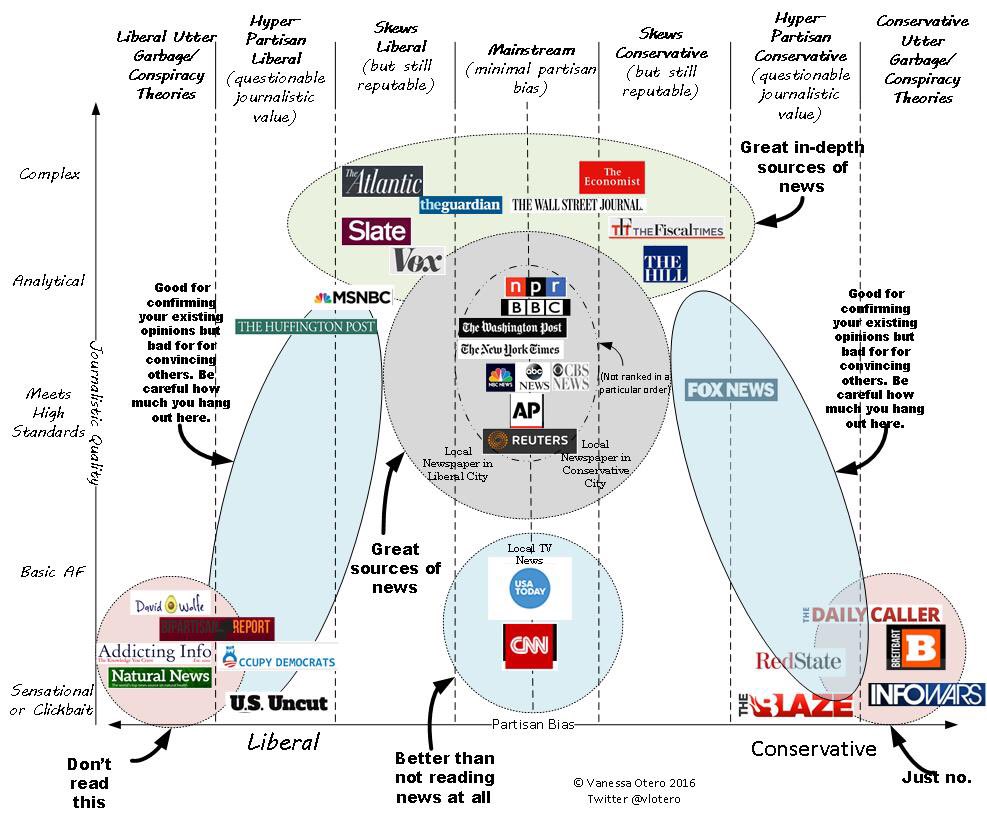
    There is no shortage of reporting out there, and it runs the gamut where integrity and accuracy are concerned. Contrary to what seems to be a widely held belief these days, there are some really great news outlets and reporters doing admirable and difficult work. Given the speed at which news seems to be coming at us lately, I have found it useful to deliberately discriminate based on the media source maybe even more than on the headline. The headline tells you what the piece is about, and on any one piece of news, there will be a dozen from which to choose. The source tells you something about how you can expect the material to be treated. There is bias in all reporting, but we should try to be honest about our relationship to that bias. The chart below matches up pretty well with my experience of the news outlets that I have some experience with. It may be a flawed exercise, but it's worth placing yourself where you think you are on this chart and seeing how your perception of your own biases matches up with which news outlets you rely on to keep you informed. Because I know I lean left ideologically, I try to avoid those outlets that have an overtly liberal slant. Obviously, I avoid the far right stuff as well because I'm not interested in doing things just for the sake of making my blood boil.

   We can be honest and careful about our personal biases. We can use reputable news sources while being conscious of their political leanings. We can verify stories or facts that seem outlandish, and place them in as wide a context as possible. We must recognize, however, that we rely on the press to bring us accurate information and facts.  One of the central tenants of our constitution is the allowance of the people to govern themselves. Crucial  to the task of self governance is the ability to hold elected and appointed officials accountable; they are after all, civil servants. There is no accountability without information; without the preservation of a shared set of facts. It is the job of the press to apply pressure to those in power and bring us information; to facilitate accountability. This has always been the role of the press and it's relationship to those who serve in public office. It has never been a comfortable relationship and it isn't supposed to be. The press is explicitly protected in our constitution because its authors loved the idea of checking and balancing; ultimately limiting the power of any single entity. The founders understood that knowledge is power, that without it the people would be weak, and that the government would not give it up willingly and honestly. This is why the press is often thought of, practically,  as a fourth branch of government acting as an additional check on centralized power. 
      In the first days of the Trump administration, we have seen an aggressive and adversarial approach toward "the media" by the president and his surrogates. The extent to which they have sought to delegitimize news outlets that challenge their narrative in particular and to demonize the profession of journalism in general is blunt, blatant, and without precedent. Sean Spicer used his first "press briefing" to berate reporters for not reporting the "truth" about the inaugural crowd size, shouting that, "This was the biggest crowd to ever witness an inauguration, period", Trump later said in a speech to the CIA that it "looked like a million, a million and a half people", Kellyanne Conway, defended the claims with this confounding semantic gem, "You're saying it's a falsehood and Sean Spicer, our press secretary, gave alternative facts to that." All this happened in the first 48 hours. The administration wasted no time in sending its message to and about "the media"; one that if it were not so chilling would be laughable.  That message, in simplest terms seems to be,"If you are not with us, we are against you, and by the way, facts are irrelevant". For a more in depth and authoritative analysis of that message, I would refer you to a piece by Jay Rosen, professor of journalism at New York University, entitled "Send the Interns".  
     The way the Trump administration uses the term "the media" is deliberate and, it too, is intended to send a very specific message. It serves to create an image of a monolith within the profession of journalism that does not exist. It deliberately ignores the diversity of thought among journalists and editorial boards for the purpose of furthering the narrative that "the media" has a collective and unified agenda to defame the administration. In portraying the press as a cohesive entity with singular intent, Trump and his explainers create a group that is simple enough to otherize.  As our new president has continued to cast the press as the "opposition party" and the "enemy", as his chief advisor, Steve Bannon tells them, they "should keep their mouth shut", there has been a lot of talk among journalists about how they should cover a hostile White House that plays fast and loose with the facts.  As the title of Mr. Rosen's article suggests, his argument is that news outlets should have someone, anyone, in the white house briefing room on the off chance that news is made there, but that it shouldn't be expected. He argues that senior reporters would be better served by looking elsewhere for the real stories. He is absolutely right. If the Trump administration wants to make a whipping boy of the press, they should not assume the role of supplicant. They should assert themselves as journalists by rejecting the demand that they act as stenographers.
    The White House Correspondents Dinner is an annual event at which  government officials, members of the press, and Hollywood elites, convene for an evening of entertainment and schmoozing. Officially the event is billed as a celebration of an independent press and is used as a venue for recognizing outstanding journalism, contributing to journalism scholarship funds, and reinforcing the importance of transparency in government.  Critics of the event have long argued that the display of coziness and chumminess between the press and those in government on whom they are expected to report is inappropriate.  In light of all the recent attacks and insults against press coming out of the White House, this year's dinner, scheduled for April 29, will have some particularly odd dynamics to sort out. The most basic question is why would any self respecting journalist want to pretend that their relationship with the White House is an amicable one? Some organizations have called for a boycott of the event; buying tickets (proceeds got to journalism scholarships) but not attending, making a spectacle of the empty room. The president has not said whether he will attend the event, but if he doesn't it will be yet another break with tradition.  It seems clear that whatever the press and those in government decide to do with respect to the dinner, it will not go unnoticed, and their respective decisions will be interpreted as statements of purpose and mission. I have a few favored news organizations, and I intend to let them know that I will be watching to see what they decide to do and say about this year's event; that how they decide to handle the situation will help me to decide if their organization is made up of journalists or stenographers. If you have "go to" news agencies, I suggest you do the same.
     

Sunday, January 29, 2017

Women's March

    Last week, on Inauguration Day, as I was posting on this blog for the first time, my wife, Kat and older daughter, Zoe were driving toward our nation's capital where they would participate in the Women's March the following day.  It is not my place to say what they were marching for; I will leave that to them, but I will say briefly what it meant to me as someone who cares about progressive causes.  On a purely personal note, I know that Kat and I, as well as many of our family and friends, were disgusted with the content and tone of the campaign season. Since November 8, it has been difficult to feel anything other than grief and deflation. As a result, conversations around the house and at gatherings have painted a picture of our current civic lives in the young minds that witness them that is decidedly gloomy. When I catch us getting too dark or when one of the kids offers up some pessimistic pronouncement for which I know I am largely responsible, I rush to try to fix it. I talk about historical perspective and the people and groups who are engaged in fights for the things that are important to them, or we talk about the deliberately conflicted construction of our government, or whatever seems like it may bolster their faith in a positive future. I want my kids to be happy. I want them to be proud of their country. I frame things for them in the best way I know how, but there is no amount of discussion that could shape their perception of the world half as much as the witness of the massive show of solidarity displayed in last Saturday's marches. Zoe is 12 years old and got to participate in a beautiful and historic event; she used her voice. Kat came home more hopeful and energized than I have seen her in a long time. Kinsey, who is 8 years old, decided she did not want to go to D.C., but has, in the past week, heard lots of positive stories and conversations and seen videos of it. The Women's March has been an uplifting force within my little family, and for that I am deeply grateful. To all of those women, and to all of those who support them, thank you.
     Aside from my family's personal experience of the marches, they were, unquestionably massive and peaceful; with the possible exception of a "biker for Trump" getting glitter thrown at him, I have not heard of any violence or property destruction or arrests. My wife's impression of the atmosphere was overwhelmingly respectful and cooperative. People came out representing a veritable cornucopia of causes, but in a unified voice and in a show of strength in numbers, they sent a very clear message to the incoming president, on his very first day in office, "There are a lot of us. We want to go forward, not back." For a man who is constantly obsessed with crowd size, at least the first part of that message is surely not lost. Maybe Donald Trump is, as he stated in his inaugural address, a catalyst for the voice of the people, for self governance; it just might not be the people to which he was referring. Maybe the Women's marches were the beginning of an answer to President Obama, when in his farewell speech, he said, this: "I am asking you to believe. Not in my ability to bring about change- but in yours.". How the rest of that answer plays out depends largely on how the energy and passion that fueled the marches is harnessed and organized over the coming years. Now I will turn the keyboard over to Kat and Zoe to share a bit of their experience of the march in D.C.

Kat-
It's so hard to know what to write about my experience at the march, mostly because I'm not sure where to start. Narrowing down why I marched is a intimidating task; I get caught up in a complicated web of all the experiences that make me who I am. So I will simply say this; I needed to do this. Because I am a woman, a mother, a teacher, a citizen.
Now, the march. Zoe and I left Friday morning to head south. We packed the car including ,of course, our hand made signs and newly knitted "Pink Pussy" hats. We decorated the windows of our car with the chalk markers I had bought specifically for that purpose. I labeled our back window and Zoe added her own designs with messages of hope and love as I drove.
It didn't take long for us to start getting friendly honks, waves, thumbs up and fist pumps as we drove. When we stopped at a rest stop in NJ the entire place was swarming with pink hats. There was a tangible feeling of excitement in the air an; expectation of being part of something big. This was just a hint of what we were headed towards.
Springfield Metro Station Saturday morning /photo by Megan Samonds

From the moment we arrived at Springfield Metro Station Saturday morning it was clear the day was going to be something special. People packed into the Metro's entry hall.  My friend Meg, had arranged for us to stay at her cousin's house Friday night and had charged up our metro cards that afternoon. As a result we were able to move quickly through the crowds waiting to purchase cards and board a waiting train. As the train made it's way towards the city the car became increasingly like a sardine can. Despite the close quarters spirits were high and people chatted amiably speculating about what the day would bring. We pulled into L'Enfant Plaza Station and a cheer rose up. Then the doors opened. The platform was bursting with people wielding signs and pink hats. I gingerly wedged myself into the crowd, carefully followed by Megan and Zoe. Periodically the crowd would break into cheering. The sound would roll through the tunnel gathering volume as it traveled.
Arriving at L'Enfant Station /photo by Megan Samonds

The climb up to 7th St. /photo by Megan Samonds
We shuffled our way up out of the station to find the crowds became a wall almost immediately. We started weaving our way through, headed down Independence towards 3rd. We made it to a spot just short of 6th right near a big screen and decided we were good where we were. There we stayed for the next six hours.

The day was filled with passionate speakers and performances. It was inspiring to hear all that was said but even more than that it was the show of support that was uplifting. To know that so many others share your concern and desire to protect each other is important. Throughout the day the crowds were respectful and calm. We were there to take care of each other and it showed. That is probably one of the most powerful things I will take away from this experience; that human decency is not dead and there are many out there who understand that we are a community and we must operate as such. Just because laws or attitudes may not impact you does not mean they are not worth fighting for. As a middle class, white, cis gender female I am surrounded by privilege. I am guilty of being complacent. During Obama's administration I was happy to let others fight the battles, comfortable with the idea that those in power would put the welfare of the people first. This was a mistake. We are country built on the idea of government for and by the people. That requires us to be actively involved in that government. Therefore, I suppose I should thank the Trump administration for kicking those of us too comfortable in our privilege out of our apathy. I ask all of my family and friends to examine their privilege. Do not allow your relative comfort to lull you into accepting the denial of rights to others. We are better than this. Our fellow citizens have been fighting this battle for generations it is high time we had their back.


Zoe-
I feared flaming trash cans, angry mobs, violence. I even feared the possibility of no return. I feared the hatred shown by our unfortunate, unqualified, unprecedented "president" would be reflected by the crowds of the march. Stacking anger and fear like building blocks, boiling blood until it was shed, I feared that I would lose the little hope I had. I was wrong. I was greeted with cheers and swarms of humans who knew who they were and would not apologize for it. I was greeted by the chants and signs of the majority voters.  I was greeted by people who care about other people. I walked away renewed, brimming with hope and confidence in my country. I walked away knowing that the annoying orange in the oval office may be my president, but he's not the president for me.
 

Friday, January 20, 2017

American Mythology

    I have been struggling to articulate, since the election of Donald J. Trump, as President of The United States of America, just exactly why I have been so deeply disturbed and confounded by it; why it has bothered me on an emotional as well as an intellectual level.  As I listened to President Obama deliver his beautiful and inspiring farewell speech, I was struck by how many times I questioned his assertions about justice or equality or our democracy. At times I even questioned whether he really could believe in those sentiments as fully as he did upon taking office eight years ago.  Maybe it took a man for whom I have great respect and gratitude, who speaks the language of American mythology eloquently; seemingly effortlessly and sincerely, to point to the bruised and battered aspects of my own personal American mythology.
      The kind of myth I am talking about here is the set of popular beliefs or traditions that embody the ideals and institutions of a society.  Like all mythologies, the American one is built out of symbols, characters, and stories that over the years have been boiled down and distilled into what we have come to understand as who we are; our values, our essence.  When we think about what it means to be American, what images, phrases, and figures emerge?  We might think of "The Declaration of Independance" with it's language about equality among men, about our rights to life, liberty, and the pursuit of happiness,  about power being derived from the governed, and about absolute rejection of despotism.  Maybe we think about our ancestors' relationships to the "American Dream",  imagining them arriving from some distant shore in search of a better life in a place where it was possible to reap the fruits of their labor.  We might also think of their arrival as the moment at which our bloodline was added to the "melting pot".  How can we not when Lady Liberty has always commanded in no uncertain terms, "...Give me your tired, your poor, Your huddled masses, yearning to breathe free..."? Clearly, some Americans think of their bloodlines' addition to the American stew in terms that are much less romantic; much more violent and forced.  Then how do we think about that great national shame? We probably take some form of the long view and some  measure of solace in the story of "Progress" in which there have been many lurches forward and major setbacks, but in which, as President Obama has said, as Martin Luther King Jr. said before him, and as Theodore Parker, an abolitionist minister said before him, "The arc of the moral universe is long, but it bends toward justice." The historical context in which each of these men expressed this sentiment is something of a testament to it's veracity.  These are only a few possible strands in the complex web of how any one of us might think about or feel a part of America.  The ways we might relate to our country are limitless and impossible to begin to scratch the surface of here, and that is, in my view, a large part of it's beauty.  However the strands of our personal experience might tie us to our nation's history, that is each of our personal American mythology.  Some are more similar than others, some seem to have very little to do with others, but sometimes we can see the few strands that are shared throughout all of our mythologies.  In my lifetime, the single best example of this was September 11, 2001. In the aftermath of that terrible day, we looked around at our fellow Americans and saw not just countrymen, but family.
       I will not attempt to make sense of all the aspects of my personal relationship to my country (you're welcome), but I will try to get at it's core; at the part I have felt so violently shaken by Mr. Trump's campaign and eventual election.  I have often cringed at the  term "American exceptionalism" because I believe in the idea that as a nation, we are and should act as a citizen in the world community and because I think it is overused and under considered by people who want to project patriotism.  While I may be skeptical of the term's use and implications, I do believe America to be exceptional.  At the heart of this exceptionalism is the fact that America is a beautiful and weird-looking mutt.  By necessity and design we are the biggest and most complete amalgamation of the world's peoples on the planet. Whether your ancestors arrived here 10 generations ago, or you recited the pledge of allegiance at your citizenship ceremony yesterday, you are part of the great American experiment.  The hypothesis for this experiment is that if we can create a framework in which peole of all ethnicities, races, and belief structures can come together and agree to hold each other to the basic rules and values laid out in our constitution, that we can shape our future, for the better, by means of a self governed democracy.  I would argue that it is this optimism that we will, through a messy, often argumentative and contentious precess, continue to thrive and prosper and in the historic perspective, progress; this idea is what makes America great. America's greatness is not measured in gross domestic product or exchange rates or in military might or international leverage or in how many of the world's billionaires and celebrities call it home. For me that greatness is measured in the collective belief in and the long term success of the experiment, and in the strength of our resolve to move confidently toward the best future we can craft for our children together.
     My understanding of American greatness may differ dramatically from yours and that's okay.  Because we are Americans we get to have our own beliefs about what our nation means to us, but it is because of what it means to me that Trump's rhetoric and behaviour throghout his campaign and transition have so offended me and has caused me to see his election as more than a swing of the political pendulum.  If Trump has been consistent in anything, it is in his propensity for putting groups of people in categories, seperate and apart from each other; The highly educated, The poorly educated, The blacks, The immigrants, The undocumented, The media, The muslims. In doing so, he consistently focuses on the differences among us. He has often tried to sow distrust or fear of one group in the hearts and minds of an other.  His constant talk of winning and disdain for "losers"  are a frequent reminder that if one group is to succeed, it must be at the expense of an other, and that if your group is not winning it is the fault of some other group.  In the days after 9/11, President George W. Bush urged Americans not to turn on their Muslim neighbors; he understood that we are stronger and safer united than we are divided.  Historically, an incoming president will use the interim between his election and inauguration to reach out to those who had hoped for a different outcome; to reassure them that he wants to do right by them even if they had decided to cast their ballot for his opponent.  Mr. Trump has used this time to communicate to the disaffected that they should get over it and to remind everyone, again and again, that he won.  This of course only serves to reinforce the message that in this situation, those of us who do not want him as our president, are in fact, losers.  For those of us who believe that America is more than the sum of it's parts, this is all deeply troubling.
     I am writing this partly to process some of this for myself and partly to give those of you who voted for Mr. Trump some idea of why some of us are not going to "get over it".  To those Trump supporters in my life who I love (and who have managed to read this far), I still love you and I hope you know that my intention here was not to offend you, but don't ask me to "give him a chance".  He told us in the primaries that once he secured his party's nomination he'd be "so presidential we'd be bored". Since then he has been many things, but presidential and boring are not among them. He has persisted with his relentless and petty twitter attacks on any celebrity, citizen, or entertainment or media outlet that says something he doesn't like while he should be figuring out how to run the government and how to unify a divided nation. I think "The Donald" has tipped his hand, and until he gives me some reason to believe that he is beginning to prioritize the execution of his new job over personal vendetas, I will reserve my right to expect things to play out just as they have so far. If the awesome weight of the job does, in fact, change the man, I will reconsider my position, but I'm not holding my breath.
    Having read about the cast of characters that Mr. Trump has chosen to fill the executive branch of our government and after watching some of their senate confirmation hearings, to say that I am concerned about what will happen over the next four years is an understatement.  I fully expect this period to be one in which the best of our charitable values and the institutions that were put in place to protect us, will be under attack. My hope is that as events unfold we will be able to prevent the worst of the damage by dragging the truth out into the light and demanding accountability.  I also hope that I am overestimating the scope of the potential destruction and that none of it will be irreversible.  I imagine, however, that when the Trump administration has left the White House, we will have to stand up, brush ourselves off, survey the wreckage, and begin to rebuild.  I know how dire this all sounds, but ultimately, I still have faith in the American people to uphold the values enshrined in our constitution and carry us through and move us forward.  I am going to try to hold tightly to the image of that "long arc of the moral universe". I will try to keep in mind that in the wide veiw, it appears as a smooth and graceful sweep, but that if we zoom in on any point along it's length we would find it to be quite jagged. I will imagine that if we zoom in further on any particular jag and examine what was happening right then, we would find along the length of it's downward slope, many people of good will and clear vision fighting tooth and nail to right the ship. Finally, I will imagine that at the bottom of the "V", that clear vision has been adopted by enough of the ship's crew, that it has once again turned it's bow toward justice.

On a final note, I would simply like to thank President Obama and his family, my daughters' first "First Family", for setting such a fine example.