Two weeks ago Donald Trump became President Donald Trump. Two weeks! So, why does it seem like so much longer? Yes, I am projecting here. For you, the passage of time may be doing its regular steady march in the wake of the inauguration, but if your experience of the last 14 days is anything like mine has been, the mind struggles to reconcile the events with the time elapsed; it feels impossible. I admit that in my case, this is largely self inflicted. I have been obsessed with knowing what's going on, what the implications are, if each thing is a break from "politics as usual", who's drawing battle lines, do they mean it or are they full of shit, and on and on. Non stop. I have read more articles, heard more statements and commentary, considered more doomsday scenarios and threats to our constitution, and seen more "presidential" bragging, whining, and chest thumping in the past two weeks than in any two month period in my life. That's why it seems like it's been forever. It's too much. It's not good. It's not sustainable. How are we supposed to process all this information?
There is a new series on Netfix called "Lemony Snicket's Series of Unfortunate Events" which I recommend if you are in need of an entertaining distraction. The refrain of its very catchy theme song is "Look Away, Look Away, Look Away, Look Away" and it goes on "This Show will wreck your evening, your whole life and your day, Every single episode is nothing but dismay". Lemony Snicket, the show's narrator often implores the viewer to find something else to watch, constantly warns that the ensuing events will be terrible and upsetting. I think the theme of knowing that for the benefit of your mental and emotional state, it may be better to look away, but that you will inevitably bear witness, serves as a pretty apt metaphor for the way I and most of the people I talk to have been experiencing the past couple of weeks. Maybe it's not such a great distraction after all. Looking away is not really an option, but we can, and I think we need to make some disciplined choices about how and at what we look. If we care about our government and are concerned about the state of our democracy, we must pay attention, lest we become one of the dreaded "low information voters", but now more than ever, we are in danger of becoming "disinformation voters." In avoiding disinformation, the responsibility falls to the producers of media, if accurate reporting is, in fact their intent (which should not be assumed), as well as to the media's consumer, you and me. In an attempt to make some sort of sense of the avalanche of recent news while keeping my biases in check, I have had to set some guidelines for myself.
Central to these guidelines is the recognition of the fact that we are all constantly making decisions, deliberately or not, that shape the way we understand the world, and that it is easier now than ever to affirm any belief we favor, no matter how wrong it may objectively be. We have all heard a lot of talk lately about how we live in bubbles, and for good reason. To some extent, this is unavoidable. We can, however, be more aware of the limits of our bubbles, try to make them contain more objective truth, and be cautious about letting the things that "seem right" in unchallenged. We can be better about recognizing our affinity for confirmation bias. Memes and bumper stickers are the perfect distillation of bias and function as quick shots of affirmation. They harden us in our beliefs. If we see one that we agree with, we get a little warm fuzzy feeling and say to ourselves "you're on my team". If we see one that we disagree with, it makes us seethe because we know "IT'S NOT THAT SIMPLE, JERK!". That's the point. Whether you like them or not, they are always too simple, there is no room for context and context is important. Ignore the memes; they are information candy. In the vein of confirmation bias, I have also tried to keep opinion and fact separate when I evaluate how much weight to grant a particular piece of news. If the headline makes a blanket judgment or tells you what to think about something, it is either bad journalism or it is an opinion piece. I am not knocking opinion pieces; there are lots of people who have really valuable perspectives that should be considered, but we should remember that no matter how admirable that perspective, it belongs to one person and is, no matter how well founded, their opinion. It should not be mistaken for a statement of fact. One last thing on what I have decided to ignore as much as I possibly can; Trump talking about Trump. Unless it has some policy or diplomatic implication, don't bother. We know, you're like, a really smart guy, you don't need information, everyone treats you unfairly, you won, yeah, yeah, we've heard it all before. I try to pay attention to the statements and actions that have consequences. Bruises to Donald's ego do not qualify.
There is no shortage of reporting out there, and it runs the gamut where integrity and accuracy are concerned. Contrary to what seems to be a widely held belief these days, there are some really great news outlets and reporters doing admirable and difficult work. Given the speed at which news seems to be coming at us lately, I have found it useful to deliberately discriminate based on the media source maybe even more than on the headline. The headline tells you what the piece is about, and on any one piece of news, there will be a dozen from which to choose. The source tells you something about how you can expect the material to be treated. There is bias in all reporting, but we should try to be honest about our relationship to that bias. The chart below matches up pretty well with my experience of the news outlets that I have some experience with. It may be a flawed exercise, but it's worth placing yourself where you think you are on this chart and seeing how your perception of your own biases matches up with which news outlets you rely on to keep you informed. Because I know I lean left ideologically, I try to avoid those outlets that have an overtly liberal slant. Obviously, I avoid the far right stuff as well because I'm not interested in doing things just for the sake of making my blood boil.
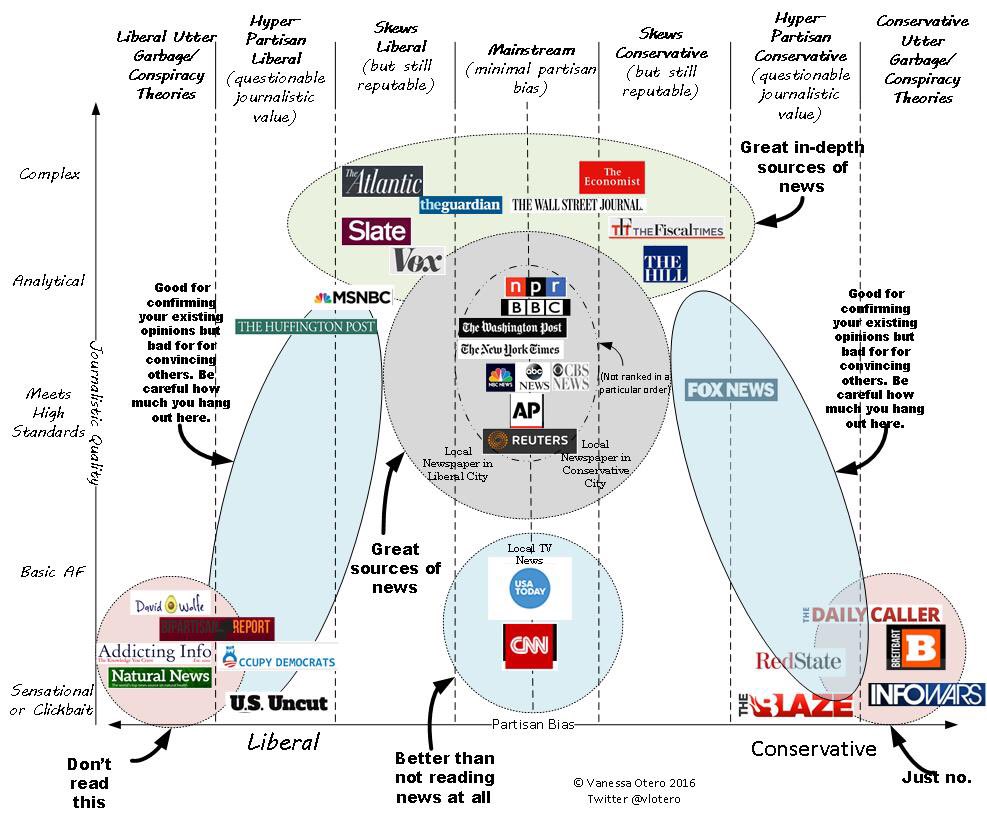
We can be honest and careful about our personal biases. We can use reputable news sources while being conscious of their political leanings. We can verify stories or facts that seem outlandish, and place them in as wide a context as possible. We must recognize, however, that we rely on the press to bring us accurate information and facts. One of the central tenants of our constitution is the allowance of the people to govern themselves. Crucial to the task of self governance is the ability to hold elected and appointed officials accountable; they are after all, civil servants. There is no accountability without information; without the preservation of a shared set of facts. It is the job of the press to apply pressure to those in power and bring us information; to facilitate accountability. This has always been the role of the press and it's relationship to those who serve in public office. It has never been a comfortable relationship and it isn't supposed to be. The press is explicitly protected in our constitution because its authors loved the idea of checking and balancing; ultimately limiting the power of any single entity. The founders understood that knowledge is power, that without it the people would be weak, and that the government would not give it up willingly and honestly. This is why the press is often thought of, practically, as a fourth branch of government acting as an additional check on centralized power.
In the first days of the Trump administration, we have seen an aggressive and adversarial approach toward "the media" by the president and his surrogates. The extent to which they have sought to delegitimize news outlets that challenge their narrative in particular and to demonize the profession of journalism in general is blunt, blatant, and without precedent. Sean Spicer used his first "press briefing" to berate reporters for not reporting the "truth" about the inaugural crowd size, shouting that, "This was the biggest crowd to ever witness an inauguration, period", Trump later said in a speech to the CIA that it "looked like a million, a million and a half people", Kellyanne Conway, defended the claims with this confounding semantic gem, "You're saying it's a falsehood and Sean Spicer, our press secretary, gave alternative facts to that." All this happened in the first 48 hours. The administration wasted no time in sending its message to and about "the media"; one that if it were not so chilling would be laughable. That message, in simplest terms seems to be,"If you are not with us, we are against you, and by the way, facts are irrelevant". For a more in depth and authoritative analysis of that message, I would refer you to a piece by Jay Rosen, professor of journalism at New York University, entitled
"Send the Interns".
The way the Trump administration uses the term "the media" is deliberate and, it too, is intended to send a very specific message. It serves to create an image of a monolith within the profession of journalism that does not exist. It deliberately ignores the diversity of thought among journalists and editorial boards for the purpose of furthering the narrative that "the media" has a collective and unified agenda to defame the administration. In portraying the press as a cohesive entity with singular intent, Trump and his explainers create a group that is simple enough to otherize. As our new president has continued to cast the press as the "opposition party" and the "enemy", as his chief advisor, Steve Bannon tells them, they "should keep their mouth shut", there has been a lot of talk among journalists about how they should cover a hostile White House that plays fast and loose with the facts. As the title of Mr. Rosen's article suggests, his argument is that news outlets should have someone, anyone, in the white house briefing room on the off chance that news is made there, but that it shouldn't be expected. He argues that senior reporters would be better served by looking elsewhere for the real stories. He is absolutely right. If the Trump administration wants to make a whipping boy of the press, they should not assume the role of supplicant. They should assert themselves as journalists by rejecting the demand that they act as stenographers.
The White House Correspondents Dinner is an annual event at which government officials, members of the press, and Hollywood elites, convene for an evening of entertainment and schmoozing. Officially the event is billed as a celebration of an independent press and is used as a venue for recognizing outstanding journalism, contributing to journalism scholarship funds, and reinforcing the importance of transparency in government. Critics of the event have long argued that the display of coziness and chumminess between the press and those in government on whom they are expected to report is inappropriate. In light of all the recent attacks and insults against press coming out of the White House, this year's dinner, scheduled for April 29, will have some particularly odd dynamics to sort out. The most basic question is why would any self respecting journalist want to pretend that their relationship with the White House is an amicable one? Some organizations have called for a boycott of the event; buying tickets (proceeds got to journalism scholarships) but not attending, making a spectacle of the empty room. The president has not said whether he will attend the event, but if he doesn't it will be yet another break with tradition. It seems clear that whatever the press and those in government decide to do with respect to the dinner, it will not go unnoticed, and their respective decisions will be interpreted as statements of purpose and mission. I have a few favored news organizations, and I intend to let them know that I will be watching to see what they decide to do and say about this year's event; that how they decide to handle the situation will help me to decide if their organization is made up of journalists or stenographers. If you have "go to" news agencies, I suggest you do the same.
